Sofa Disposal Singapore: The Complete Guide to Getting Rid of Your Old Sofa
By Junk Value Team
Sofa Disposal Singapore: The Complete Guide to Getting Rid of Your Old Sofa
The decision is already made. The sofa is going. Maybe the leather is cracking and the foam underneath has gone flat. Maybe you bought a new one and the delivery crew won't take the old one away. Maybe you're handing back an HDB flat and the sofa is the last thing standing between you and your keys-return appointment.
Whatever brought you here, the question is the same: how do you actually get a sofa out of a Singapore home?
In our 10+ years of clearing Singaporean homes, sofas are the single most common bulky item we handle. They're also the one people get stuck on most often, because a sofa is awkward in ways that a fridge or a wardrobe isn't. It's wide, it's soft enough to wedge itself into tight spaces, and it's heavy enough that two people can't always muscle it through a narrow HDB corridor without a plan.
This guide covers every route available to you, what each one actually involves, and the specific details that matter depending on what kind of sofa you own and where you live.
How Does Sofa Disposal in Singapore Actually Work?
Three routes. Each with a real trade-off.
Town council bulky-item collection is free, but it comes with conditions most people don't expect. Your town council will collect bulky items on scheduled days, but the item must be dismantled first. A whole three-seater sofa left at the void deck won't be picked up. You need to break it down into manageable pieces yourself, then leave it at the designated collection point on the right day. We cover the full process in our town council bulk item collection guide, and if you want to understand how scheduling works estate by estate, the HDB bulky item collection schedule breakdown goes deeper.
Doing it yourself means dismantling the sofa, getting the pieces downstairs (through a standard HDB passenger lift or, worse, down the stairwell of a walk-up block), loading them into a vehicle, and driving to a disposal point. If you own a van and have a free Saturday, it's doable. Most people don't.
A paid pickup service is the third option. A crew arrives, handles the dismantling if needed, carries everything out, and takes it away. You pay for the convenience and the labour. That's what we do.
No route is universally "best." The right one depends on your timeline, your budget, and how much physical work you're willing to take on.
Can the Town Council Take My Sofa for Free?
Yes, with a significant catch: the sofa must be dismantled before the town council will collect it. Whole sofas, intact frames, full sectionals left at the void deck — these get skipped.
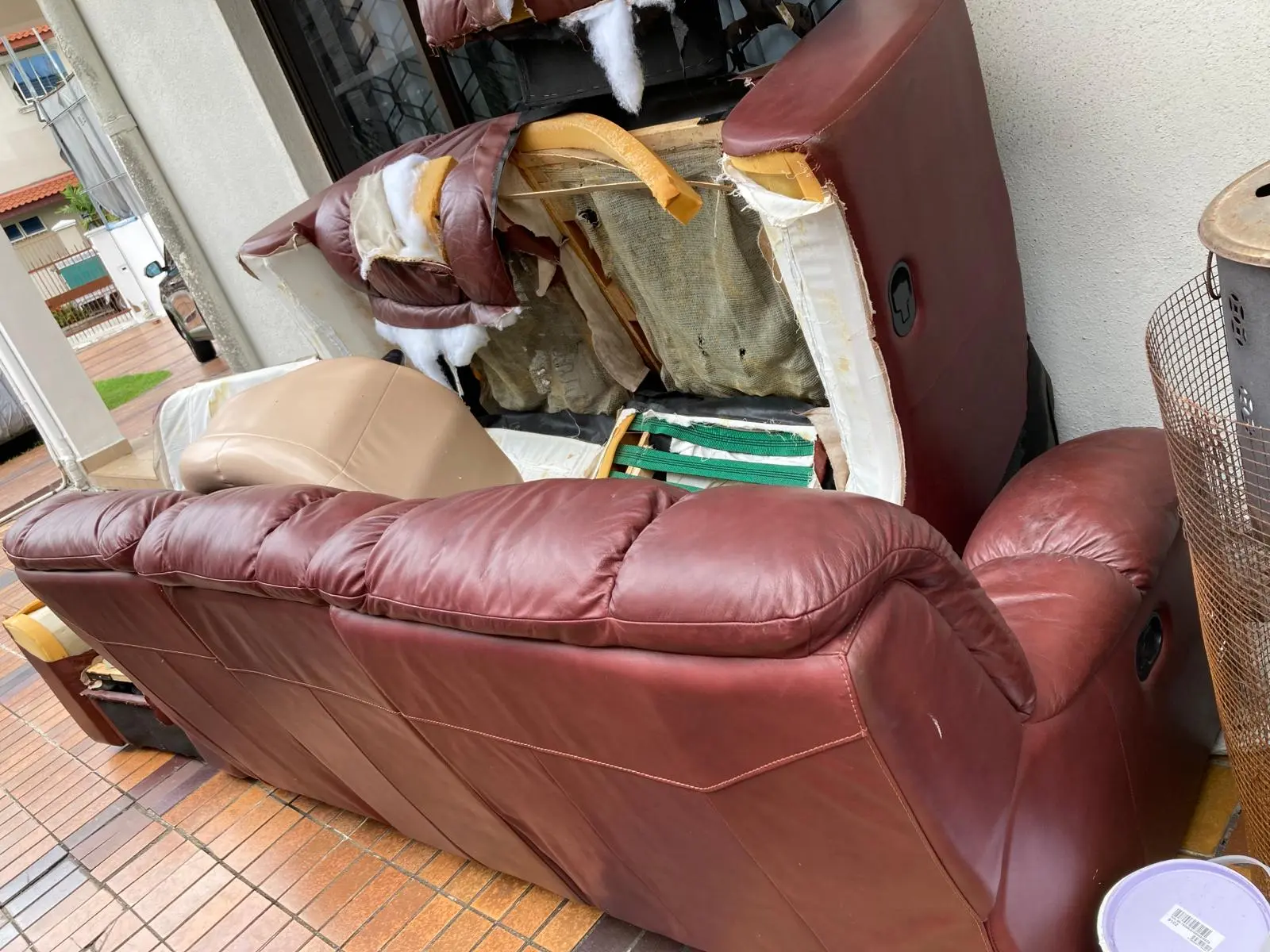
Dismantling a sofa yourself is more involved than most people assume. A typical three-seater has a timber or metal frame, stapled upholstery, foam padding, and sometimes spring coils inside. You need tools — a pry bar, heavy-duty scissors or a utility knife, possibly a reciprocating saw for the frame. It takes time, it's messy, and you still need to bag or bundle the debris for collection.
If you leave an intact sofa at the void deck without going through the proper collection process, it creates problems for your neighbours and your town council. Our post on what actually happens with void deck bulky item disposal explains why this matters more than most residents realise.
The dismantling requirement is exactly where a paid service adds value. We dismantle as part of the job — the customer doesn't need to touch a saw.
What Kind of Sofa Are You Getting Rid Of?
Not all sofas are the same job. The type you own changes the weight, the dismantling approach, and whether it'll clear your doorway in one piece.
Two-seater sofas are the simplest. Usually under 40kg, narrow enough for most HDB doorways, and manageable for a two-person crew without dismantling. These are the quick jobs.
Three-seater sofas start to get interesting. A fabric three-seater might weigh 50–60kg. A leather one with a hardwood frame can push past 70kg. Width becomes the constraint — many three-seaters measure 200cm or more across, and a standard HDB doorway is about 90cm wide. The sofa often needs to be tilted, angled, or partially dismantled to clear the frame.
L-shaped and sectional sofas are actually multiple pieces joined together, which sounds like it should make things easier. Sometimes it does — if the sections disconnect cleanly, each piece can be moved independently. But many L-shapes have a corner unit that's bulky and oddly shaped, and the connecting brackets underneath aren't always designed for repeated assembly and disassembly. We've pulled L-shapes apart in living rooms across Clementi and Jurong West where the corner section alone weighed more than a standalone two-seater.
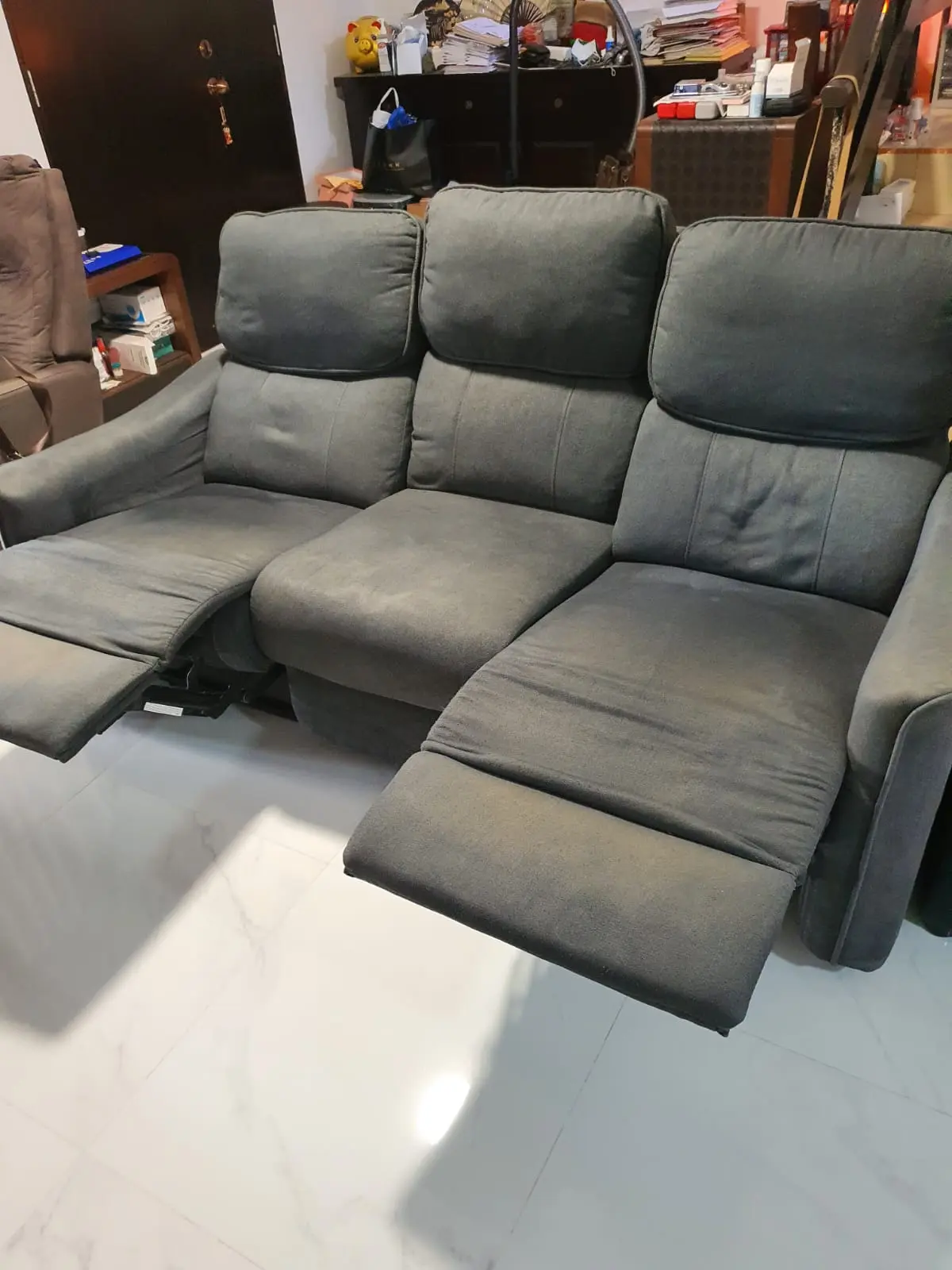
Recliners are deceptively heavy. The reclining mechanism adds a steel frame, springs, and sometimes a motor (for powered recliners) that can push a single-seat recliner past 50kg. A three-seat recliner sofa with all three seats powered? That can exceed 120kg. The mechanism also makes the piece deeper than a standard sofa, which complicates doorway clearance.
Sofa beds carry a foldout metal frame inside. That frame roughly doubles the weight of what looks like a normal sofa. A sofa bed that two people could sit on comfortably might weigh 80kg or more because of the bed mechanism hidden inside. We cleared a sofa bed from a Queenstown unit where the metal frame alone weighed as much as a single mattress — our Queenstown sofa bed disposal case study walks through exactly what that job looked like from truck to yard.
Modular sofas (the kind where each seat is a separate cube you can rearrange) are usually the easiest to move piece by piece, but the total volume adds up fast. Six modules that individually weigh 15kg each still means 90kg of sofa going down the lift.
When you send us photos for a quote, this is exactly what we're assessing: type, estimated weight, and whether the piece will need to come apart before it leaves the room.
Will It Fit Through the Door and Down the Lift?
Two measurements decide whether your sofa walks out the front door or needs to be dismantled first.
Measure the sofa's widest dimension. For most sofas, that's the length (armrest to armrest). For recliners, also measure the depth with the footrest extended — that's often the dimension that catches.
Measure your doorway and corridor. HDB main doors are typically around 90cm wide. The corridor outside might be slightly wider, but the turn from your unit into the common corridor can be tight, especially in older blocks where the corridor layout doesn't give you a straight run to the lift.
The lift is the next bottleneck. HDB passenger lifts vary by block age and design, but a common internal dimension is roughly 150cm deep by 130cm wide. A two-seater stood on its end usually fits. A three-seater often doesn't without tilting or partial dismantling.
If you live in a walk-up block with no lift at all, every floor of stairs adds to the difficulty — and the cost. Our guide on walk-up HDB bulky item removal challenges covers what's involved.
For tight corridors and awkward turns, the narrow corridor furniture removal tips post has practical advice whether you're hiring us or attempting it yourself.
The photos you send us at the quoting stage should include the sofa, the doorway, and the path to the lift or stairs. We've done this enough times to look at a photo and know whether a piece will clear the turn or whether it needs to come apart in the living room first.
Does the Sofa Need to Be Dismantled First?
Sometimes, yes. And this is the part most people underestimate.
If the sofa fits through every doorway and into the lift without dismantling, we carry it out whole. Faster for everyone. But when a sofa is too wide, too deep, or too heavy to move safely in one piece, dismantling in the unit is the practical answer.
What dismantling looks like depends on the sofa. A fabric sofa with a timber frame might need the legs removed and the back section detached from the seat — many sofas are built with bolted joints at the back that allow this. An L-shaped sectional gets separated at its connecting points. A recliner might need the mechanism disconnected so the back can be lifted off the base.
Sofa beds are the most involved. The metal foldout frame is usually bolted or riveted to the sofa's main structure, and it needs to come out before the piece is light enough to move safely through a narrow space.
We handle dismantling as part of the job. You don't need to take anything apart before we arrive. If you're curious about the DIY-versus-hire decision for dismantling in general, our post on how to dismantle a wardrobe in an HDB flat lays out the reasoning — the logic applies to any large piece of furniture.
Is It Different in a Condo?
Meaningfully, yes.
Condo buildings are managed by an MCST (Management Corporation Strata Title), and each MCST sets its own rules for moving bulky items in and out. Some require advance booking of the service lift. Some restrict bulky-item moves to specific hours. Some require lift padding to be installed before any furniture goes into the service lift.
Two things to know about our role in this: we do not liaise with building management on the customer's behalf, and where lift padding is required, it is provided by the building management, not by us. Rules differ per building, and the owner or tenant must request permission and any lift booking from their MCST ahead of the pickup day.
Our condo bulky item disposal guide covers the general process, and the condo service lift booking guide explains what to arrange with your management office before collection day.
For HDB flats, the logistics are different. HDB blocks do not have a designated service lift — everything goes through the standard passenger lift. That's why the measurement step matters so much for HDB residents. The lift is smaller, the corridors are narrower, and there's no separate goods lift to fall back on.
Landed properties are usually the simplest from an access standpoint — ground floor, wide doors, direct vehicle access. The sofa comes straight out the front.
What Happens to the Sofa After It Leaves?
We get asked this often enough that it's worth being straightforward about.
Sofas that are still in usable condition — structurally sound, upholstery intact, no heavy staining or odour — get routed into second-hand channels where possible. Reuse is the best outcome for any piece of furniture, and we make that call based on the actual condition of what we collect.
For sofas past their usable life, the materials get separated where practical. Metal frames and springs go to metal recycling. Timber frames go to wood recycling channels. Foam, fabric, and mixed materials that can't be economically separated go to intermediaries who do further sorting before the residual waste reaches its final destination.
We don't have neat percentages to quote, and we won't pretend every sofa gets a second life. Some are genuinely done. What we can say is that we route materials through the most responsible channels available rather than sending everything to the same place regardless of condition.
What Should You Have Ready Before Collection Day?
A short checklist that makes the job faster for everyone:
Send photos of the sofa from at least two angles — one showing the full length, one showing the depth and height. If it's a recliner or sofa bed, mention that in your message. These details affect the quote.
Measure the sofa and your doorway if you can. Even rough measurements help us plan whether we're carrying it out whole or dismantling first.
Know your floor number and whether your building has a lift. For HDB walk-ups, the floor number directly affects the job scope.
Clear the path. Move side tables, coffee tables, and anything between the sofa and the front door. The less manoeuvring we need to do around other furniture, the faster and safer the removal.
Remove loose cushions, throws, and anything stored inside a sofa bed. We're taking the sofa structure — personal items left in the cushions have a way of disappearing into the truck.
For condo residents: confirm with your management office that the service lift is booked and any required padding is arranged before our arrival.
Clearing More Than Just the Sofa?
Most sofa disposal jobs we handle aren't solo items. The sofa is going because the living room is being redone, or the whole flat is being cleared for handover, or a renovation is about to start and everything needs to go.
If you're clearing multiple bulky items on the same day, it's almost always more efficient to do it in one trip. A sofa, a mattress, and a bed frame from the same unit go on the same truck, same crew, same visit.
For larger-scale jobs — entire flats being emptied before renovation or lease return — our full HDB clearance service covers the whole scope from bedroom to kitchen.
And because the bedroom often goes at the same time as the living room: mattress disposal and bed frame disposal are among the most common add-ons to a sofa removal job. Mention everything you need cleared when you send your photos, and we'll quote for the lot.
Sofa Disposal FAQs
Do you collect the sofa from inside my unit, or do I need to bring it downstairs? We collect from inside the unit — that's the whole point. Our crew comes to your door, handles the carrying (and dismantling if needed), and takes it all the way to the truck. You don't need to move it to the void deck or lobby.
What if the sofa won't fit in the lift? This happens regularly, especially with three-seaters and L-shapes in older HDB blocks. If the sofa can't fit into the passenger lift even when tilted, we dismantle it inside the unit so the pieces can be carried down. For walk-up blocks without a lift, the crew carries everything down the stairs — surcharges may apply for stair access, confirmed at the quoting stage.
Do you buy old sofas or offer any trade-in value? No. We're a disposal service, not a buyback operation. We don't pay for items collected, regardless of condition. Where a sofa is still reusable, we route it into second-hand channels, but the customer does not receive payment for it.
How much notice do you need to book a sofa removal? Typically 24–48 hours for a standard job. Urgent or same-day requests may be possible subject to availability, and additional charges may apply. Send your photos via WhatsApp and we'll confirm timing along with the quote.
Can you clear other items on the same trip as the sofa? Absolutely — and most customers do. Mattresses, bed frames, dining tables, appliances, renovation debris. If it's all coming from the same address, one trip is more efficient for everyone. Just include photos of everything you need cleared when you message us.
Related Reading
- Sofa Disposal Service — How It Works
- Disposing of an Old Sofa in an HDB Flat
- HDB Furniture Disposal Guide
Ready to get rid of the sofa? Send us a few photos on WhatsApp — the sofa, the doorway, and your floor number — and we'll get back to you with a quote. No obligation, no site visit needed for most jobs.
👉 WhatsApp us at 9888 1292 for a free quote.