Wardrobe Disposal Singapore: Freestanding, Built-In, and Everything In Between
By Junk Value Team
You're standing in the bedroom staring at a wardrobe that's been there since your parents moved in. Maybe longer. The renovation contractor starts next Monday, and the wardrobe needs to go — but nobody's told you whether it unscrews from the wall or whether someone has to saw it apart in place. You're not even sure it'll fit through the front door in one piece.
This is the most common call we get. Not "please remove my wardrobe" in the abstract, but a specific person in a specific flat, usually with a renovation deadline, trying to figure out the sequence: what comes apart, what gets cut, what goes through the corridor, and who handles each piece.
In our 10+ years of clearing Singaporean homes, we've removed wardrobes from every era — 1960s solid rosewood pieces that needed four crew members and a furniture dolly, flat-pack IKEA PAX systems held together by wooden dowels and cam locks, and floor-to-ceiling built-ins that were essentially part of the wall. Each type is a different job. This page walks you through all of it.
How Do You Dispose of a Wardrobe in Singapore?
You have three realistic options, and which one applies depends on one question: is the wardrobe freestanding or built-in?
Option 1: Town council bulky-item collection. Your HDB town council — whether that's Ang Mo Kio–Hougang, Tanjong Pagar, or any other — will collect bulky items from the void deck or designated collection point. The catch most people miss: they require items to be dismantled first. A whole wardrobe sitting at the void deck won't be picked up. You'd need to break it down into flat panels yourself, carry those panels down (HDB flats use standard passenger lifts, not service lifts), and leave them at the collection point on the right day.
Option 2: DIY dismantling + disposal. If you're handy and the wardrobe is a bolt-together flat-pack, this is doable. We cover the honest reasoning in detail below.
Option 3: Professional removal. A disposal crew handles everything — dismantling or cutting, carrying through corridors and lifts, loading, and routing items for recycling or disposal. This is what we do, and our wardrobe removal service covers the full scope from bedroom to truck.
The real fork in the road isn't which option you pick. It's whether your wardrobe is freestanding or built-in, because that changes the tools, the time, the mess, and the cost.
Is It Freestanding or Built-In?
This is the single most important thing to figure out before you call anyone — us included.
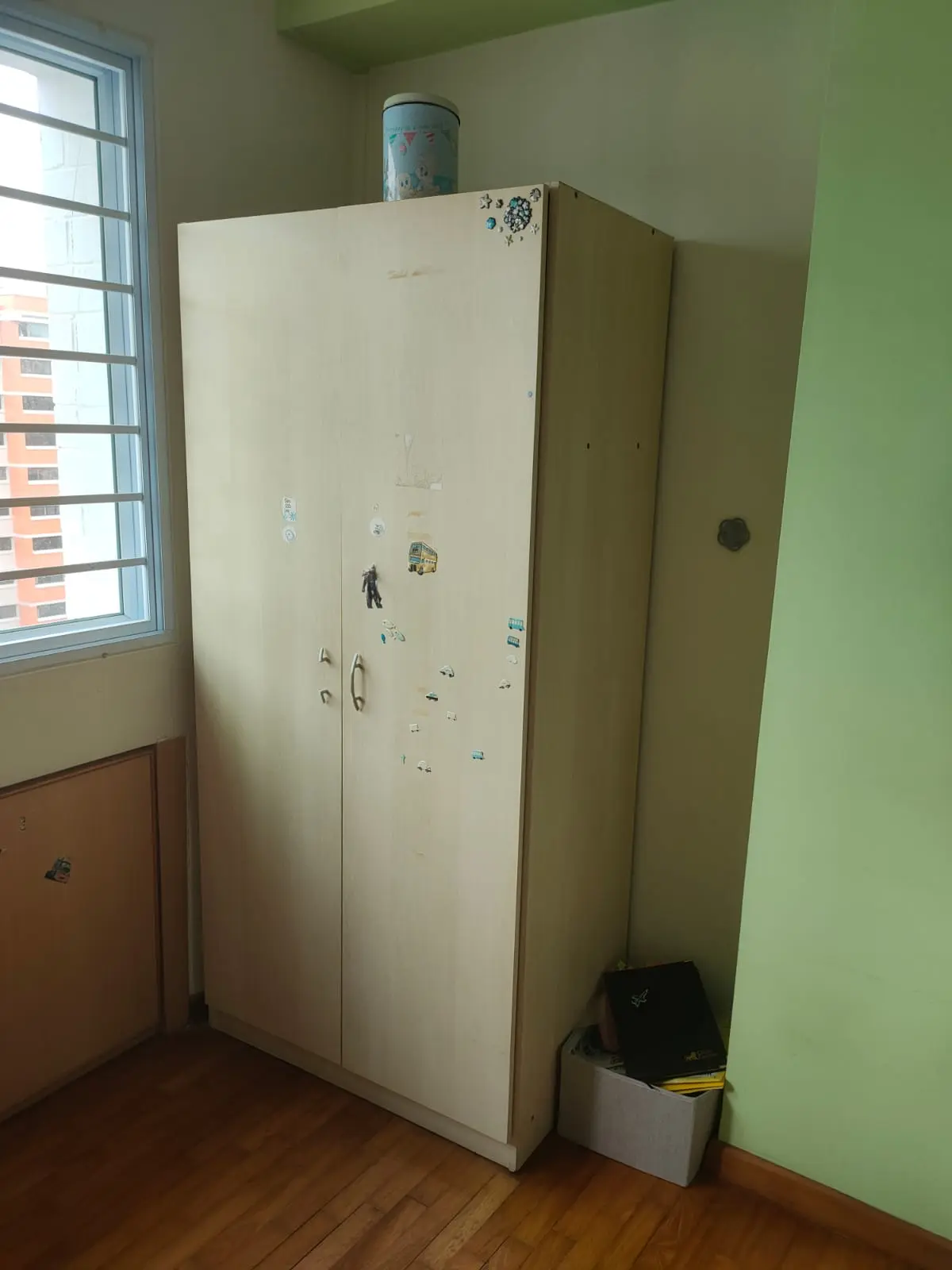
Freestanding wardrobes sit on the floor as a self-contained unit. They might be screwed to the wall with an anti-tip bracket (IKEA does this), but the wardrobe itself is a box that was assembled in the room and can, in theory, be moved out of it. Look behind the wardrobe if you can. If you see a gap between the back panel and the wall, and the wardrobe has its own base and top, it's freestanding.
Built-in wardrobes are a different animal entirely. They use the room's walls as their side panels, back panel, or both. The shelves and rails are mounted directly into the masonry. The doors hang from a track fixed to the ceiling or a header board. There's no "back" to the wardrobe — just the bedroom wall. Many older HDB flats from the 1970s through 1990s had these installed during the original fit-out, and they've been there so long that homeowners sometimes forget they're not furniture. They're construction.
A quick test: open the wardrobe doors and knock on the side panel. If it sounds hollow and thin (like MDF or plywood), and you can see where it meets the ceiling with a filler strip or cornice, it's almost certainly built-in. If the side panel is the same material as the shelves and feels like a solid furniture piece, it's probably freestanding.
Why does this matter so much? A freestanding wardrobe gets unscrewed, possibly disassembled into panels, and carried out. A built-in wardrobe gets cut out — with a reciprocating saw, pry bar, and sometimes an angle grinder if there are metal brackets set into concrete. The built-in job takes longer, creates debris (drywall dust, wood splinters, exposed raw wall), and requires cleanup that a freestanding removal doesn't.
Should You Dismantle It Yourself?
For some wardrobes, DIY dismantling is genuinely practical. For others, it's a weekend you'll regret.
Good candidates for DIY: IKEA PAX, MUJI shelving, and similar flat-pack systems. These were designed to be assembled by one or two people with an Allen key and a Phillips screwdriver, and they come apart the same way. Remove the doors first (lift them off the hinges), then the shelves, then the rails. Unscrew the cam locks connecting the side panels to the top and base. You'll end up with flat panels that stack against a wall and fit into a passenger lift without drama.
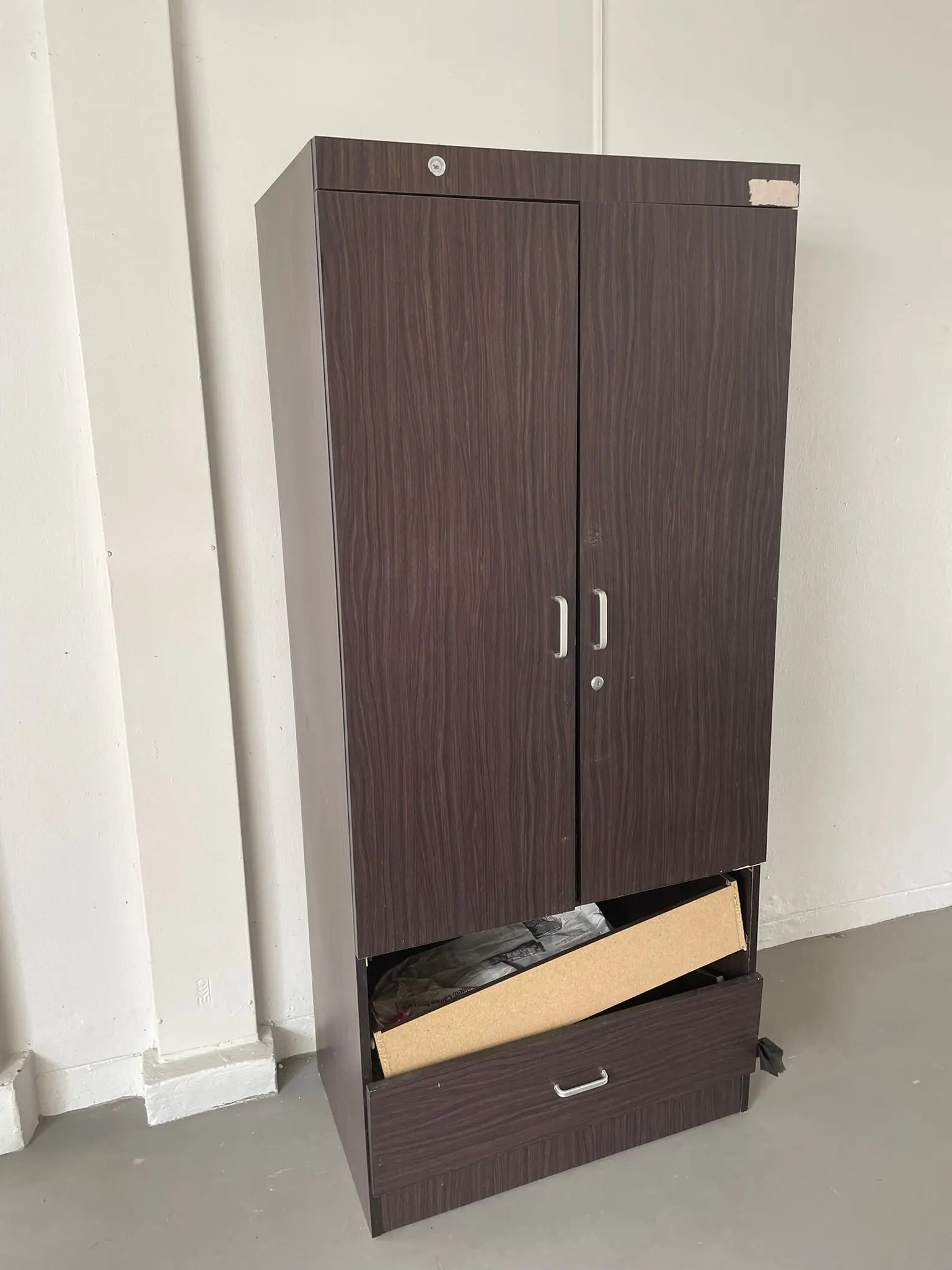
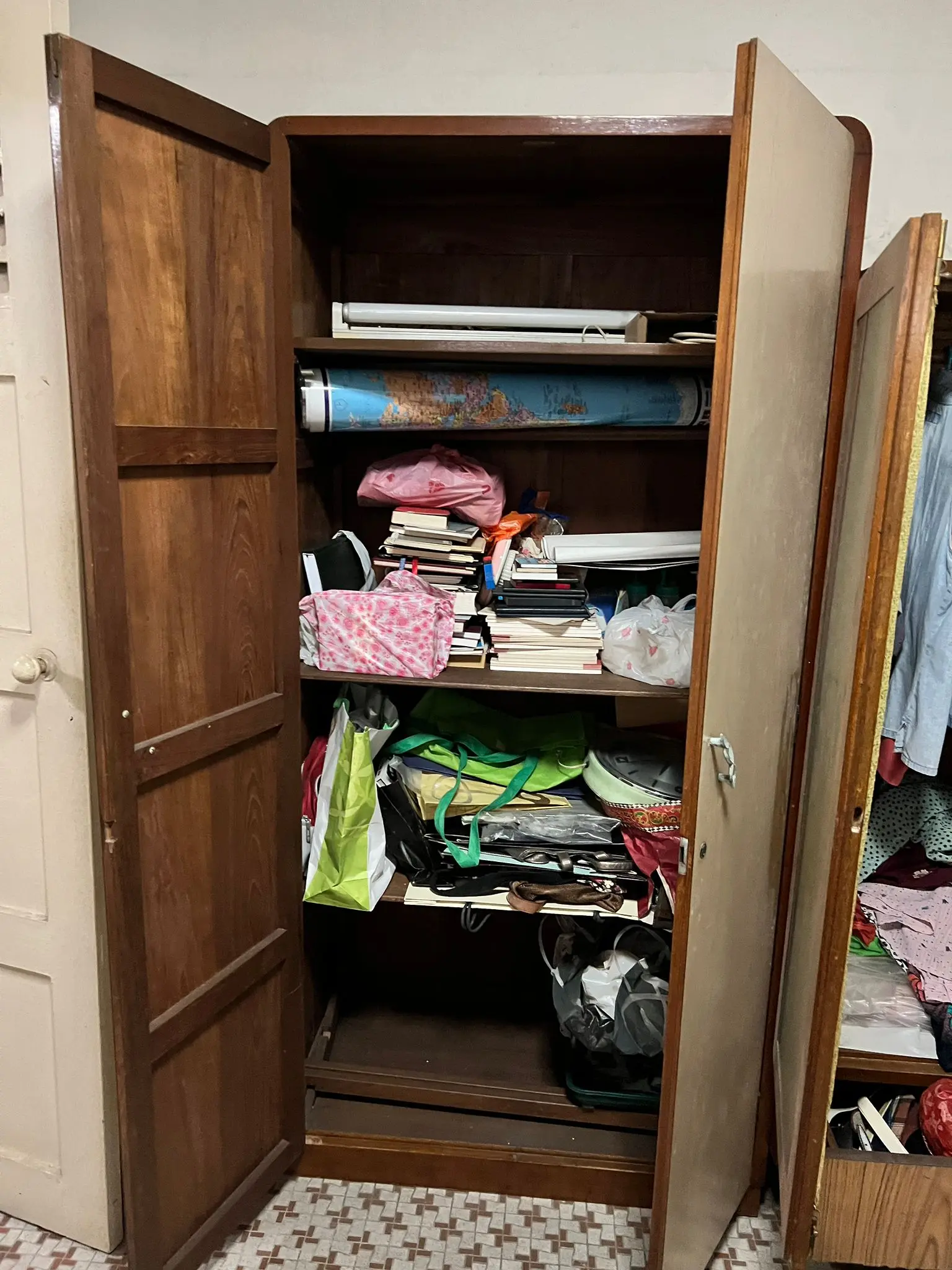
Bad candidates for DIY: Solid hardwood wardrobes from the 1960s and 70s — the kind with mortise-and-tenon joints, real teak or rosewood panels, and drawers that weigh as much as a small desk. These weren't designed to come apart. Forcing them risks splitting the wood (which doesn't matter if you're disposing, but matters if you drop a panel on your foot) and the sheer weight of each piece makes manoeuvring through an HDB corridor a two-person minimum job.
Impossible for DIY: Built-in wardrobes. Unless you own a reciprocating saw and are comfortable cutting through plywood panels that are screwed and glued into concrete walls, this isn't a weekend project. We've written a detailed walkthrough of how to dismantle a wardrobe in an HDB flat that covers the tools, the sequence, and the honest assessment of when to stop and call someone.
What Happens to the Wall Behind a Built-In?
Nobody talks about this enough, and it catches homeowners off guard.
When a built-in wardrobe is removed, the wall behind it hasn't seen daylight in 20, 30, sometimes 40 years. At minimum, you'll find a different paint colour. More commonly, you'll find raw concrete or plaster with screw holes, anchor points, adhesive residue, and patches where the original wall was never finished because the wardrobe was always going to cover it.
We remove the wardrobe structure and clean up the debris — wood offcuts, dust, screws, bracket fragments. What we leave behind is a bare wall surface. Making that wall good again (plastering, skim-coating, repainting) is your renovation contractor's scope, not ours.
If you're removing a built-in wardrobe specifically because a renovation is coming, the sequence matters. Get the wardrobe out before the contractor starts, not during. Contractors price their plastering and painting based on the wall condition they can see. If the wardrobe is still there when they quote, they'll either add a contingency or come back with a variation order once they see what's underneath.
One more thing we've learned from clearing dozens of these in older Ang Mo Kio and Clementi flats: the electrical wiring in some older HDB units runs behind the built-in wardrobe. Before any cutting starts, it's worth checking with your contractor or an electrician whether there are live cables in the wall cavity. We don't do electrical work, but we've seen enough exposed wiring during removals to know it's worth five minutes of checking.
Will It Fit Through the Door and Lift?
This is the logistics question that determines whether a wardrobe walks out in one piece or comes out in panels.
Standard HDB bedroom doors are about 760mm wide. Standard HDB main doors are about 900mm. A typical two-door wardrobe is 900mm to 1,200mm wide, 550mm to 600mm deep, and 1,800mm to 2,000mm tall. Even if the wardrobe is narrower than the door frame, you need clearance to angle it through — and HDB corridors have a 90-degree turn between the bedroom and the front door that eats up manoeuvring space fast.
For freestanding wardrobes that can't be disassembled (solid wood, glued joints), we often remove the doors and shelves to reduce weight and width, then tilt the carcass to navigate the turn. Sometimes that's enough. Sometimes the carcass still won't clear, and it needs to be cut in half on-site.
The lift is the next bottleneck. HDB passenger lifts vary by block age, but a common internal dimension is roughly 1,100mm wide × 1,400mm deep × 2,100mm tall. A wardrobe laid on its back might fit diagonally — or it might not. We assess this from your photos during the quoting stage, which is one reason we ask for measurements or a photo of the wardrobe next to the doorway.
Condo service lifts are larger, but access rules differ per building. If you're in a condo, your MCST may require you to book the service lift in advance and arrange for lift padding. That's between you and your management office — we don't liaise with building management on your behalf, but we can tell you what to ask for when you call them.
For walk-up HDB blocks without a lift, or situations where the wardrobe must go down via the stairwell, surcharges apply. We'll confirm that at the quote stage so there are no surprises.
What About Kitchen Cabinets and Shelving?
Everything we've said about built-in wardrobes applies almost identically to kitchen cabinets. Upper wall cabinets are screwed into concrete through mounting rails. Lower cabinets are often built around plumbing. The countertop may be a single slab of granite or quartz that's siliconed to the cabinet boxes and backsplash.
Removing kitchen cabinets means cutting, prying, and dealing with the wall and floor surfaces underneath — which, just like the wardrobe wall, were never finished. Our kitchen cabinet removal service handles the full scope, and we've written a step-by-step HDB kitchen cabinet removal guide that explains what's involved, what to disconnect beforehand (gas, water, electrical), and what your contractor needs to handle after we're done.
Bookshelves and standalone shelving units are closer to freestanding wardrobes in terms of logistics. Most IKEA BILLY or KALLAX units disassemble with a screwdriver. Heavier teak or display cabinets with glass doors need more care. We cover the full range in our bookshelf and shelving unit disposal guide.
The common thread: if it's bolted to the wall, it's a removal job. If it stands on its own feet, it's a carrying job. Both need to fit through the same corridor and the same lift.
What Should You Empty Out First?
This sounds obvious, but we mention it because at least a third of the wardrobe jobs we arrive at still have items inside. Clothes on hangers, shoeboxes on the top shelf, documents in drawers, mothballs rolling around the base.
Before collection day, go through the wardrobe and sort everything into three categories:
Keep. Box it and move it to another room. Don't leave it on the bedroom floor where we'll be working — the corridor between the wardrobe and the front door needs to be clear for carrying.
Donate or sell. Clothes in good condition can go to textile collection bins (most HDB estates have them near the recycling corner) or second-hand platforms. Do this a few days before, not the morning of.
Dispose with the wardrobe. If you have old clothes, broken hangers, or miscellaneous junk that's going out anyway, you can leave it inside the wardrobe and we'll take it all. Just let us know at the quoting stage so we factor in the extra volume.
One thing people forget: check the top of the wardrobe. Especially in older flats, the gap between the wardrobe top and the ceiling becomes a storage shelf for suitcases, CNY decorations, and things nobody's looked at in a decade. Clear that first.
Also check for wall-mounted items near the wardrobe — mirrors, hooks, picture frames. If they're in the path between the wardrobe and the front door, take them down. We're careful, but a 60kg wardrobe carcass being tilted through a doorway doesn't leave much margin for a framed photo on the adjacent wall.
Clearing a Whole Room?
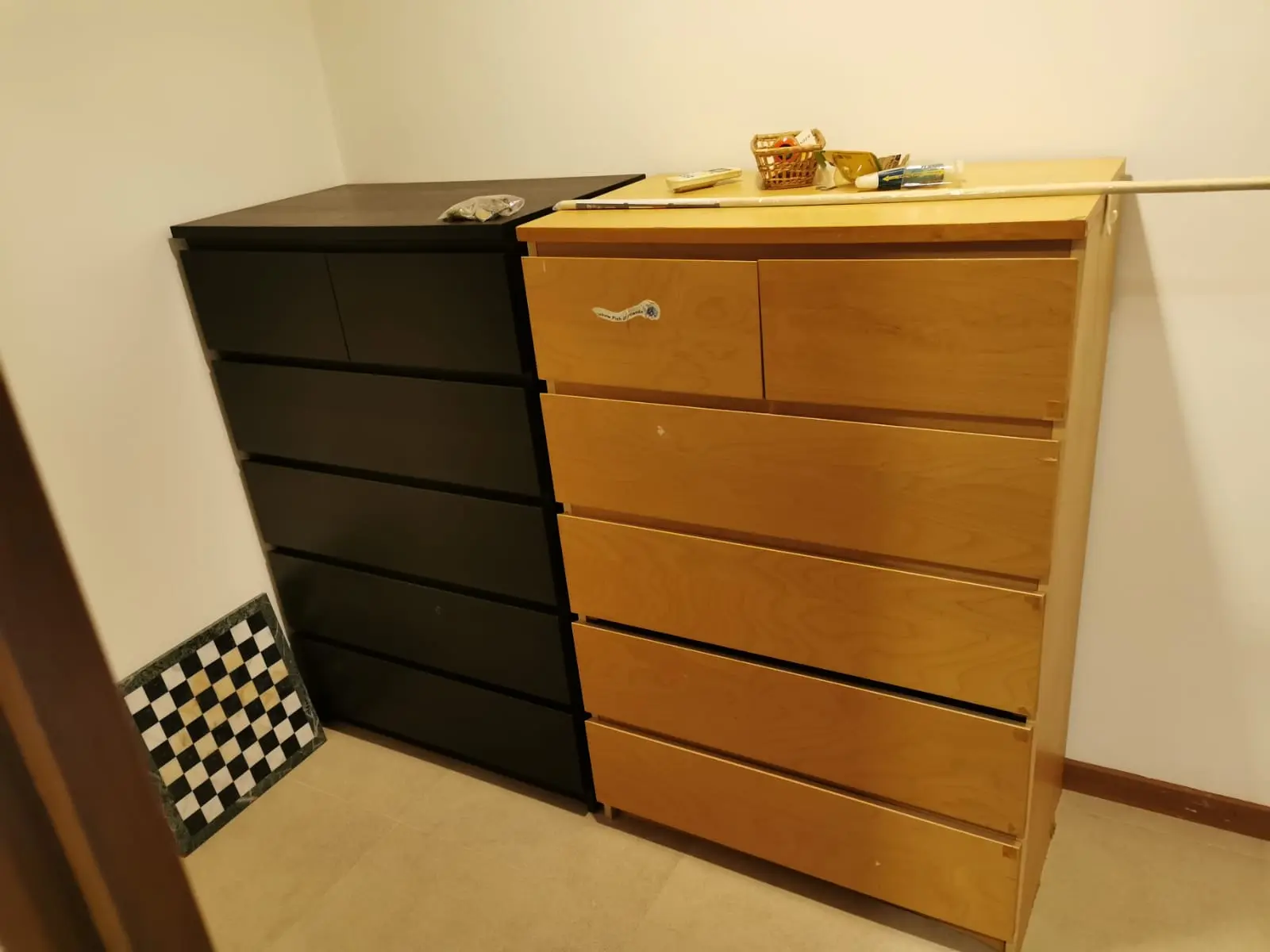
If the wardrobe is just one piece in a full bedroom clearance — bed frame, mattress, side tables, dresser, maybe a desk — it usually makes more sense to clear everything in a single trip rather than scheduling separate pickups.
A full-room or full-flat clearance follows a different rhythm. We work room by room, starting with the largest pieces and working down to the small items, clearing a path to the front door as we go. We've done full HDB flat clearances in Ang Mo Kio where every room had decades of accumulated furniture, and the whole job — from first wardrobe to final sweep — took a single morning.
Our HDB furniture disposal guide walks through the full process for a multi-room clearance: what to sort before we arrive, how to sequence the rooms, and what "broom-clean" means when we leave.
Wardrobe Disposal FAQs
Do you buy wardrobes or offer trade-in value for old furniture? No. We're a disposal service, not a buyback operation. We don't pay for items we collect, regardless of condition or brand. Where a piece is still in reusable condition, we route it into second-hand channels where possible, but no cash or credit changes hands.
Can you remove a wardrobe without dismantling it? Sometimes. If the wardrobe fits through the doorway and into the lift as a whole unit, we'll carry it out intact — it's faster for everyone. Most two-door wardrobes wider than about 1,000mm need at least the doors removed, and many need partial or full disassembly. We assess this from your photos before confirming the job.
How quickly can you collect? We don't guarantee same-day or fixed response windows, but we accommodate urgent requests when availability allows. Additional charges may apply for short-notice, after-hours, Sunday, or public holiday pickups. Send us photos on WhatsApp and we'll confirm timing along with the quote.
Do you clean up after removing a built-in wardrobe? We remove all debris generated by the dismantling — wood panels, screws, bracket fragments, dust. We sweep up the immediate work area where we can. What we don't do is patch, plaster, or repaint the wall surface left behind. That's renovation contractor territory.
What if I'm not sure whether my wardrobe is freestanding or built-in? Send us a few photos on WhatsApp: one of the full wardrobe front-on, one showing where the side panel meets the wall, and one showing the top where it meets the ceiling. We can usually tell from those three angles and will let you know what the removal involves.
Related Reading
- Wardrobe Removal Service — Full Details
- How to Dismantle a Wardrobe in an HDB Flat
- Narrow Corridor Furniture Removal Tips
Ready to get that wardrobe out? Send us a few photos on WhatsApp — the wardrobe, the doorway, and the corridor — and we'll come back with a free quote, usually within the day.